Monday, March 13, 2006

a sad time


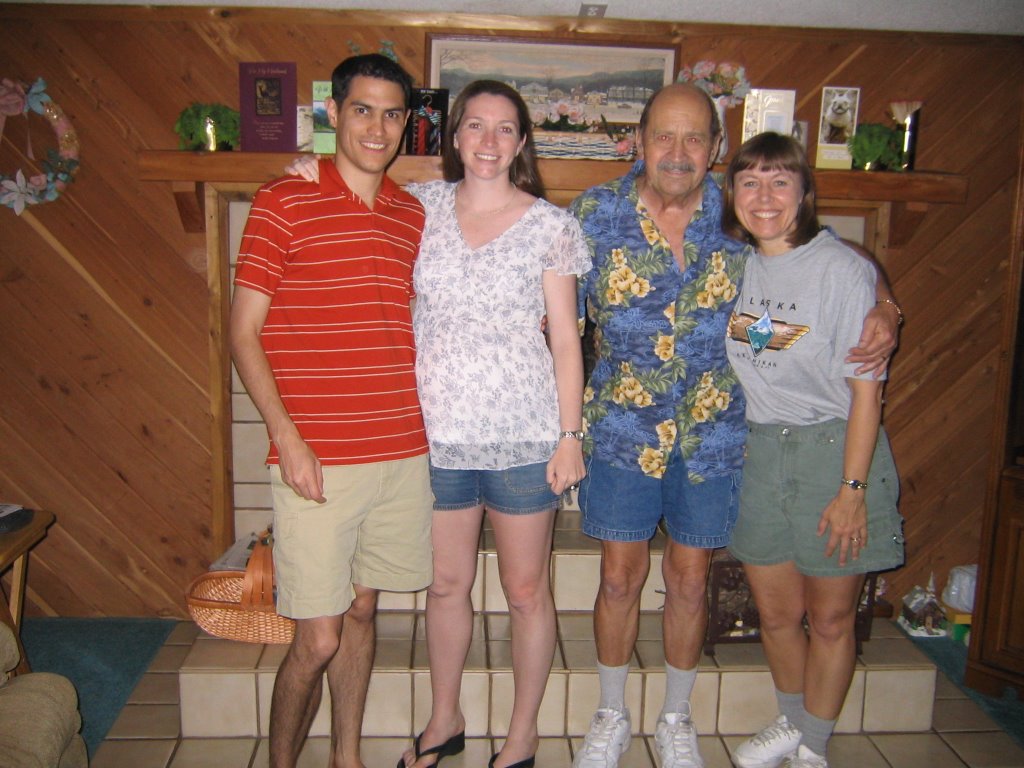
got news yesterday that my grandfather is on his final decline from cancer. We knew it was coming- we were in Florida two weeks ago saying our good byes and making sure that Grandpa got to meet his great grandson. (This picture is from June of 2004; I am about six months pregnant here. This is before his cancer got really bad.) I wrote this poem, a pathetic attempt to tie together images and emotions as well as emptiness. . .but I feel better having written something. everything is prose these days.


trickle down brown stones. walking in autumn woods. dogs, a chorus, an answer. inside, talk of winter and ash. quietly but slowly. so much so, I have to turn around. we will carry, they say, until it drops. pockets full of tissues. punctual. lighting the pilot. waiting to ignite or expose. I have kept them all, the cards. the occasions for your words. your handwriting tall and slender like spruce trees, bending in an easterly. winter wind. bending as you recline. moving backwards through the polyps on your spine. we are laughing; we are laughing with you. dog is quiet, curled like a branch. the garrulous wind. speaking sends me back. today I have read three books about reading. mustard flour, not mustard flower. i fear for your sleep, your neverwaking. hoping. impossible to go the wrong way. the precise science of death, hiding in the doghouse, is calculating your worth.

Monday, March 06, 2006

Migrane

I went to a conference on Saturday, an all-day endeavor that was meant to expose, poke, prod, reconfigure answers to the question (statement?) "How to read. What to do: The future of poetry criticism." Drawn to this event by an impressive list of presenters, including my advisor, Jennifer Ashton (others are Brett Bourbon, Stanford University, Steve Burt, Macalester College, Jeff Dolven, Princeton University, Oren Izenberg, University of Chicago, Maureen McLane, Harvard University, Mark Payne, University of Chicago, Jennifer Scappettone, University of Chicago, Gabrielle Starr, New York University), I thought it would illuminate some evidence that might help me muddle better through issues I'm having with some of my exam lists, namely my "Evolution of the Lyric" theory list. I left the event at the end of the day with a migrane. . .the first migrane I've ever had.

Maybe it was the size of the egos in the room that left so little space for my own mind and thoughts that made my head hurt so badly. Or maybe it was that people kept talking about "poetry" as if it was something we could define, something we could all agree on exactly what that meant, while there was obviously a very specific "kind" of poetry, namely old white male poetry, that is most highly esteemed. At one point, poetry was compared to a car, as a mechanism to take you from one place to another. I have to admit, this is the most vacuous definition of poetry I've ever been forced to wrap my mind around. Granted, the context was more complicated that I'm creating here, but still. It was a hard pill to swallow.

For me, the last panel was the most interesting, presenting on issues that I'm most interested in, namely, post modernism with some feminist theory thrown in. But I was even disappointed with this. Feminism seemed to be talked about as if it were a "lesser form of theory," lesser, definitely, than the ideas of Kant or Celan, whose names were mentioned so many times, I lost count. At one point, an older gentleman, the one who had been spouting about Kant earlier, asked the women on this panel, "You don't actually consider the sonnet a male-dominated form of poetry, do you?" Thank the gods for Jennifer Scappettone, who answered that though she was merely commenting on Jennifer Ashton's discussion of Rachel Blau De Plessis, she was not Rachel Blau Du Plessis. She did, however, think that women have been taught a certain tradition of the sonnet since we were young, a male-dominated tradition, shown that only males write this poem well, and therefore we have as women, stood outside of this tradition with little opportunity or models of where we fit in. I guess in a way, I felt similarly about the entire conference-- like I was standing outside of a discussion that didn't include me, that didn't value the things about poetry, myself and other's, that I hold as important, like subjectivity, poetic tension, language itself and our relationship to it in our time. Instead we talked about cars and spaceships, and whether or not a poem could drive a car to Paris, France, even if we built a bridge.

I also felt distant as a woman who believes, to a certain extent, in an essentially feminine poetics or aesthetic. Having actually carried a child in my body for nine months makes me a different animal from a man who cannot do this-- I am other, essentially(and, I would venture to guess, different from 99% of women at the conference, who are not mothers). That doctors had to cut me open to remove this baby from me has changed my entire perspective on the world. That my body produced another being, with the initial help of a lonesome sperm, yet that it was not able to deliver this being, has changed my complete belief structure, thus my relationship with language. I cannot trust my body; I cannot trust language either to deliver something or anything.I cannot trust a poem to drive to Paris, even Paris, Texas. I am left, instead, to discover the grief and simultaneous elation that language carries, complete with contradictions and erasures. This is my truth, but there was no room for it in that room.

My life, also, is so different from the majority of people in that room-- My world contains the chaos, failures, elations, and exhaustion of being a mother first and an academic/poet second. There is, for me, no other way to do it. This is why I embrace an idea I found recently in Kathleen Frasier's essay "How did Emma Slide? A matter of gestation." She proposes a different form of poetry, one so tightly linked to process as a reality for me, that I nearly fell out of my chair when I read it: "My mind was working double-time. I was thinking about childbirth, its interior unfolding process; then child-rearing and the infinite interruptions it promises. How we want them, how we don't. . .that the ambivalence for women artists around the issue of children and mates will never be resolved. I thought of the word 'gestation' in this context, and when I stood up to read, I began first to speak of our survival-as-artist needs and suggested that it was time we formally acknowledged this interruptive pattern as an exact set of movements , a newly-evolved poem model that carried its own imprint for the recognized and partly intentional nature of our lives. I named this new for the Gestate," and she continues to define it as a form that allows for a slow unfolding of thought and values detail, but also welcomes leaps in perception. I love all of this and agree with it very much, but love most the description of "the partly intentional nature of our lives." I have felt for some time that my poems do have intention, but it is not purely my own; (which was, actually a topic brought up at the conference, imagine it!) it is driven by the chaos of my subconscious as well as the absolute chaos of my life, moment to moment. I love it. It is essentialist, but so what, I guess I want to ask. I contradict myself, so did Whitman. That was his most effective poetic trope!

The moment of the conference that I enjoyed most was when Oren Izenberg's baby was in the hallway, screaming, while someone was trying to make a profound and deep point. I could see the look on people's faces, the utter terror and disbelief in their eyes. You might as well have run nails down a chalkboard. I loved it. That was the only moment of the conference when I truly felt at home.
Tuesday, February 28, 2006

the perfect use of a semicolon

It is billowing like a butterfly; my attention is flying.
Guarantee a snowstorm; go fishing early.
You dreamed you were on a seashore; you are really on a staircase.
The broken thought is finishing; the thought is done.
He could not handle the embrace; he would have cried and shaken.
He cried and shook; his shaking was electric.
I wish for undertones; please understand.
Undertow; under snow.
You dream you are a carefully constructed grammar; you fragment.
Finding his pulse is the hardest part; he used to be faster than seasons.
The thing you search for is here; you search for spiraling punctuation.
Please wait for the children; they are coming.
Help me; I am shaking.
Her secret is downstairs; her downstairs is a clear conversation.
I love him; he is not correct.
Go to the seashore; they are waiting for you there.

Friday, February 10, 2006

Consistently Astonished

I'm both astonished and extremely comforted by the fact that people still read this blog, even though I have been so remiss in posting. Like my own little cyber-support group. That I have been doing more thinking than writing is not necessarily a good thing, especially since the culmination of all this thinking will soon be a lot of writing-- fast, time-pressured writing-- the mere thought of that is enough to make me mad (mad in the British sense, not angry, though there is a bit of that, I suppose). This is to say that the few loyal visitors are so very extremely appreciated, and I wish I had more to offer these days in terms of profound realizations and insightful poems, but alas, all I have is astonishment.

Same as it ever was. . .

Friday, February 03, 2006

A quick update

I'm still alive, though not blogging much or really keeping up with other blogs. . .sorry guys. I'll come back gangbusters in April when these exams are over. I can;t even imagine life without the burden of studying. Aaah. Can't wait.

Looks like Scott Glassman and I will be in the upcoming edition of Dusie, thanks to Scott's submission efforts of our collaborative piece. We're pretty excited about it, especially since they responded in less than 24 hours. Scott and I agree that it's a new record, for us anyway. It should be out in mid-February, so stay tuned.

Mostly, I've been reading hermit-like and thinking about big, complicated ideas and meanwhile not able to compose a simple sentence. I'm reading my favorite book of all time, Theresa Cha's Dictee so all is right with the world :) It's even on my list!

I'm also applying to several teaching positions in Colorado, some community colleges, some Universities. We'll see if I get any interviews. Keep your fingers crossed for me.

Hopefully more later, but who knows. LOTS left to read, and only two months to do it.

Saturday, January 14, 2006

not having much to say but talking anyway


That's how I felt too after the holidays and spending almost three weeks at my parent- in- law's house. I'm still amazed that I survived. Eliot is just now getting back on schedule and back to some semblance of normalcy. Though for a toddler, there's a sliding scale there. . .

This was the first week of classes, which went pretty well and smoothly. I'm teaching a poetry workshop of only 15 students, so nothing to complain about- I've taught this class enough times to be able to relax. It's interesting to be simultaneously reading all of this pedagogy theory about creative writing, much of it very thought provoking. I didn't expect to be this excited about my pedagogy reading list, but it has turned out to be one of my favorite lists. My advisor on this list, Professor Ann Feldman, is so supportive as well. She's interested in the way I'm synthesizing the things I'm reading and integrating them into my own practice. This seems to me to be the epotome of a great pedagogical model- theory and practice equally balanced. It's been great so far.

I've been pleasantly surprised by some acceptances in the pase several weeks, one to Alligator Juniper in Arizona and one to the Briar Cliff Review in Iowa. I also recieved two separate letters, one form Fourteen Hills (a great, great magazine) and Folio out of American U in DC, personalized to me. These letters both say that the editors like my poems very much but that they just didn't fit in that issue. I was very excited by these letters, which both invite me to re-submit for the next issue. I had never recieved letters like these (nor had I ever really written anything exactly like them when I was an editor) and I was very touched by them, almost more than an acceptance in some ways. The effort is above-and-beyond, which I totally appreciate. I will DEFINITELY resubmit.

Well, off to read Whitman and figure out exactly how he fits into my Urban Poetics list. If anyone (Mary??? Simone??? or anyone else??? PLEASE?) has any insight on this, please let me know. And if I figure anything out, perhaps I'll post later about my findings.

Monday, January 09, 2006

to be back

We've been back for a week, but time is just not something I have a lot of right now. I'm behind on my reading for exams, weeks behind, in fact. My exams are in a matter of weeks at this point, and I'm only about 1/2 way through my lists. Unreal. I suppose this is when I start to refine my skills in skimming. . .

I've been completely uninspired to write and feel like that's OK for now.

I'm completely stressed out and want to hide under a rock. Today is the first day of Spring semester, and I teach tomorrow. Brutal. I pray for good students this semeater.

I hope to fill in more details later. . .now, I'm off to read about creative writing pedagogy.

Tuesday, December 13, 2005

interesting

Right now, I'm awaiting the departure of my husband and son to Colorado. They're flying there today and leaving me here to my own devices for a few days-- I'm looking forward to some concentrated study time for sure. I haven't read a thing in almost a week and a half. I haven't been alone like that for years, though, and sit here wondering what it will be like. Hmm. I'm excited.

I've been thinking a lot lately about a distinction that I tend to make in poetry, dismissing poetry that is traditional and boring as being "bad" poetry. Poetry not often worth reading. I think this is a misstep on my part, and I feel the need, mostly for myself, to clarify something. This internal struggle began when I made a comment about Mary Oliver a few weeks ago and many people commented that thay appreciate her poetry for various and different reasons. For me, this was a valuable exchange. I personally find Oliver's work to be redundant and boring, but there was a time in my life when I appreciated her poetry for the things it does well. Her poems do some work on some level and therefore may be interesting to some people at some times in their lives. Right now, I find her work un-interesting. For me, this is the most important quality of a poet's project-- or, even in some cases, do they have a project? Is their project just to tell a story? Or is there something about the disruption of the narrative or rearrangement of time or something about the telling of that story that makes it into something I would call interesting? By all means, I am not the authority on interesting or uninteresting poetry, but a poem should do new work, be taking a step in one direction or another. I'm a firm believer in the poet's role to innovate, even on the smallest level. I feel like a lot of contemporary poets are in a rut, stuck in the same lyric patterns we've been in for 20 years, writing the same uninteresting poem about the same uninteresting things over and over, and because the poetry world is comfortable living in this paradigm, these are the totem voices of contemporary poetry. Meanwhile, I'm excited about poets of my generation who are embracing even the slightest bit of innovation and living it, saying it. The wonderful women in my poetry group are a testament to this fact.

I feel like I should be more specific, while at the same time I am reluctant to hold someone up as "my ideal of interesting" and the antithesis. Maybe I'll rhuminate some more and post again later. I do have four days to think about poetry! Such an exciting prospect!

Monday, December 05, 2005

Gearhead


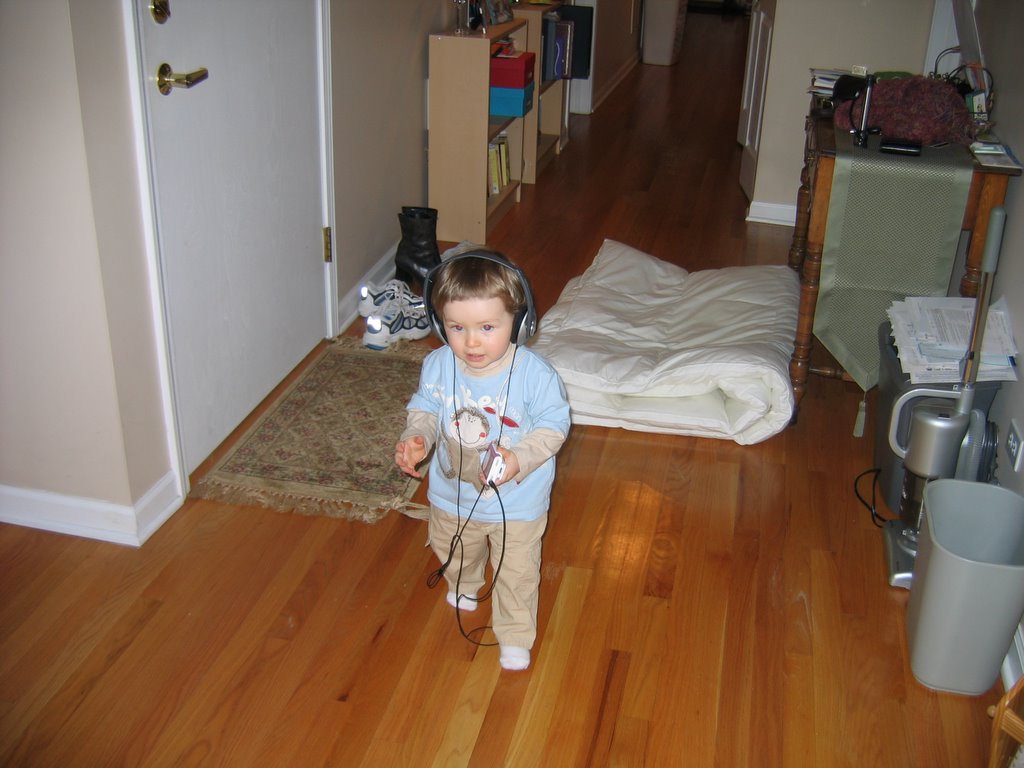
Eliot has entered the information age at only 14 months old. He looks like a 15 year old here, and yes, he really was listening to music on my ipod, though he's only now learning how to program. We have to hide our digital comera, laptops, cell phones and ipods because he's addicted. So bizarre. What did kids do before the computer age? Play with twigs? I remember playing with ants in the dirt. And that was in the early 80's.

Friday, December 02, 2005

Check this out!

Check out Scott Glassman's podcast on 30 days. Awesome. I definitely would do some dancing if Eliot wasn't sleeping in the next room. My favorite part is what he does with "makeup line (abyss edit)"-- funky and obsessive, as every good poem-jam should be :). I definitely enjoyed this. Where does he find the time?

Wednesday, November 30, 2005

xray

I misread “enzyme” for “analyze” without going back. You should care where it started, where my bones began to spur and flower into cunning disruptions. Against a taupe wall? In the unparalleled red dress? You too would snow bone if you lived here. The wind would bring it to you; no thoughts of snapdragon or peapods to comfort. The vapors are wrong about you. I am wrong about you. You are wrong about bones, their ability to liquefy and drown you, flood each alveoli like an upside-down tree. I can see through you like a bizarre scissor, stand you against any landscape and conjure your sockets, filaments, crystals. You look like a wind chime against ocean spray, limbs skewed but always parallel as you sleep. This is what I see, aside from your proteins, their tidy assembly, their march through the kingdom.

Monday, November 28, 2005

If you've got it, flaunt it. . .

Well, since it's fairly rare that I get any kind of props from the outside world of poetry, I thought I'd brag about my recent accomplishment. I got word from the Chaffin Journal that they found my poem, "Reaching into the Same Pockets," worthy of a Pushcart Prize nomination. I metnioned the Chaffin Journal a few months ago because of how amazed I was by their professionalism and attention to detail, which so many journals these days neglect (as someone who has edited many a journal in my day, I mean this not as a criticism to other journals, but as a complement to Chaffin, which is doing an exceptional job at something that is very difficult). I am definitely honored by this nomination-- who wouldn't be? To me, it's a big deal that someone respects my work enough to send it forward, to say, "there's something here that I think someone would like to read as well." This for me as a poet, is the biggest accomplishment of all. I guess we'll just wait and see what the pushcart people think of it :)

Otherwise, my life consists of a lot of reading (I mean a lot) and continued collaboration with Scott on our Helixes project and another soon-to-be-done semester of classes. A lot of meeting and discussion with my exam faculty committee members. I have a fifth reader (someone who does not do a list or question with me but reads the exams and is part of the deferse process) who is a wonderful man named Dr. Michael Lieb- he does some really cutting-edge research on Jewish Mysticism as well as Milton (separately). Not a lot of sending poems out, with the exception of my book manuscript to numerous contests. Let's home I have some more good Karma coming my way.

My blog is down to like 15 hits per week. I suppose that's to be expected since I've been writing so infrequently.

Wednesday, November 16, 2005

I'm on a roll

apparently, writing only on Wednesdays. Not really interesting at all, is it.

I'm in the thick of reading a lot about Susan Howe, which means reading a lot of feminist theories and thinking a lot about "feminist poetry," whatever that means. I've also been re-reading the introduction th Elizabeth A. Frost's new book, which focuses on the Avant Garde women's tradition and how it has been marginalized. Some really interesting and compelling stuff, and completely on topic for the list, which seems to have turned into a discussion on exactly this subject. It brings up a lot of unresolved issues for me, like what kind of work is a poem doing if the reader hasn't a clue what it means? For me, this relates to Howe specifically, and rightfully so. Howe seems to be resisting a "common" reading of her poetry at every turn, masking and remasking, unbuilding and further unbuilding, in an effort to completely obliderate meaning and trajectory. In the book I'm reading of hers, Singularities, she does provide a context, but that's the only framework she allows besides the page itself, the material object on which the text is written. I laughed while I was reading the E. Frost essay about Howe's work, and she tries to do a line-by-line reading of Howe, which completely falls apart by the end of the essay. Why? Not because Frost doesn't know what she's talking about but because Howe's work exists in order to resist such a reading, to elude anything relating to communication or narration and exists instead as fragmented collections of language that creep up through the cracks in history that most of us didn't even know were/are there. This is to say that Howe seems to be doing some admirable work in "Feminist poetry," whatever that is.

On the other hand, I recieved a copy of Calyx: a Journal of Art and Literature by Women which at first glance is doing great things for women in literature by publishing us, but upon closer inspection, like in an actual reading of the journal, I was extremely disappointed (in the poetry, at least, on which I am going to comment). They do a great job, as usual, of representing diverse voices, blah blah blah. Good for them. There are women of all different shaes, sizes, ages, and colors in there. That's admirable, of course. The problem lies in the fact that regardless of color, shape, age, etc. all of these voices sound exactly the same. Every poem has the exact same tone, almost every poem has the same subject. Seven of the seventeen poems open with an image of the sky. There's not a single prose poem, not a single poem that is even close to being experimental at all. The titles tell it all: "Winter Stars," "Under the Sun," "My Angel," you get the picture. A few saving graces include "Ants" and "The Swifts" (the ending, anyway). Otherwise, the poetry in this journal might as well have been written by the same faceless woman with the same timeless experience, writing the same poem that starts with the sky. I'm disappointed, so I wrote this poem in response to this journal, asking for something more in terms of "diversity":


Yet another poem that begins with the sky


Because opening a poem with the sky is the easiest way to open, the interior blank distance mirrored into memory as if time unfolds outward from a vanishing point, which is usually a specific tree or an unnamed star. And then, as to be expected, the sky somehow reminds her of her mother, of a still interior moment that relates only to clouds and porcelain plates, dining room moments that broke too soon. A ridge draws itself as we approach a face, moons are eyes, and so on. By now, I do not care about the sky, how tangled up in memory we all are, how many mothers lie in hospitals and weep because the trees click like maracas when they shake in the breeze in the darkness in the night against the sky. Give me bathrooms and soap-scum, ants, an interlinear palimpsest. Give me a gargantuan zest, something indelicate and phallic, towering over us like Jack’s beanstalk. If it must be a moment, show me how you mount it, how you take it all inside until it shows itself as a filmstrip running through your eyes. The sky, the sky has been done. Give me the red smear glide of every month and tell me why, this time, this very immaculate time, this month is different.

Wednesday, November 09, 2005

While eating a tuna fish sandwich. . .

I thought I'd update. Why not? Tuna fish is so good.

I went to a stellar poetry reading last night through Columbia College: poet Rick Barot read some stellar poems. While he purports to be all about form, his poems presented themselves in graceful flow, as fluid and un-figid as possible. This seems to be quite an accomplishment, really- to embrace form so fully yet still maintain a grace and elegance. The poem that was most memorable for me is "Magnolia": it has Abraham Lincoln, a magnolia, and a laundromat in it. Not to mention the fact that it is one long, very elaborate sentence written, no joke, in couplets. It is extremely elegant. And if you get a chance, check out Roger Pao's discussion of it from this summer. I'm obviously not the only fan.

In other big and exciting news, my friend Simone Muench's new book, Lampblack and Ash, has made the transition from word into flesh and, in bodily book form, is hitting shelves and amazon.com in the very near future. I was lucky enough to get a sneak-peek last night. . . and it's awesome. The poem called "window," hidden innocuously in the middle of the collection, is a knockout. The first poem as well, though I can't remember the title, is fabulous. Check it out.

I continue to trudge on, now reading Susan Howe and trying to make some sort of sense of it all without getting too frustrated. I mean, she's amazing, but sometimes I'm just like, "what? What the hell is she talking about?" Which I suppose is exactly the point. And she's half Irish, which makes her all the more cool. I feel like her poetry is all about context- like she works very hard to present us with a context and then disrupts it by disregarding and semblance of language as social function. I have a feeling that she's darker than I think she is, like down in the core. I feel like she masks this too much- she doesn't let the darkness assume its own power and it just downright makes me nervous. Timebomb style.

I finally got my rejection from Conduit, nine months in the making. That lays to rest the first batch of poems I sent out after the baby was born, sometime back in February. It's probably time for one more big submission push, though I'm not sure I have the energy for it. It definitely feels like I have a lot of better things to worry about.

Friday, November 04, 2005

writing little but reading a lot

I'm embarrassed to say that I just finished reading Wordsworth's "Preface to the Lyrical Ballads" for the first time in my life, and all of a sudden, feminist experimental poetry makes all the more sense to me. For starters, I tried my damndest not to be offended every single time he spoke of how poetry = man, the soul of man, manhood, mankind, etc. But it got to be too much after a while, and it became clear that he really was talking not about "man" the species but "man" the gender. Lines like this really got me: "But various causes might be pointed out why, when the style is manly, and the subject of some importance, words metrically arranged will long continue to impart such a pleasure to mankind as he who proves the extent of that pleasure will be desirous to impart." I forgive him, of course-- he lived in a different era. At the same time, it's not like there weren't women writing poetry when he was writing- there was Charlotte Smith, Anne Finch, even his own sister, Dorothy, was a writer and poet. I find it more ironic than anything- that this piece of writing is aimed at making poetry more accessible through its language structure, aiming "to choose incidents and situations from common life, and to relate or describe them, throughout, as far as was possible in a selection of language really used by men." But no, really I'm over it. . .I think. . .

Anyway, I'm embarassed because this really is a pivotal piece of writing from which a majority of contemporary poetry gains its authenticity and power-- I should have read it by now. (I've also yet to read Moby Dick- don't tell anyone. They're lible to hold my PhD hostage!) Not to say that we would still be writing in verse if it were not for Wordsworth, but things would surely look different. As far as my focus on the lyric poem as a form, this piece is also crucial in the movement from a stress on meter to a stress on emotion, which carries a lot of contemporary still today and seems to be a component in poetry that is "cherished." This often tends to be the type of poetry that bores me to tears- poetry whose sole purpose is to make the reader "feel" something specific and profound without really even thinking about it. You want an example, you say? I stumbled across this Mary Oliver poem on poetry daily- aside from containing the most blatant and forceful pathetic fallacy I've seen in years, its just plain sappy and melodramatic.
See for yourself:


Song for Autumn


In the deep fall
don't you imagine the leaves think how
comfortable it will be to touch
the earth instead of the
nothingness of air and the endless
freshets of wind? And don't you think
the trees themselves, especially those with mossy,
warm caves, begin to think

of the birds that will come — six, a dozen — to sleep
inside their bodies? And don't you hear
the goldenrod whispering goodbye,
the everlasting being crowned with the first
tuffets of snow? The pond
vanishes, and the white field over which
the fox runs so quickly brings out
its blue shadows. And the wind pumps its
bellows. And at evening especially,
the piled firewood shifts a little,
longing to be on its way

Yuck. It's plain-spoken, alright. But to a fault if you ask me. That's my 10 cents, not that anyone asked.

I also had a meeting with my advisor on Tuesday and we talked about how I need to work on focusing my prose writing and following my train of thought all the way through to some sort of conclusion that ties things together. From the paragraphs above, it's obvious that she is right on the money with this critique. I think this blog will be a good place to practice this skill, as I don't want my exams to be a random smattering of ideas with no connective tissue or some strange wandering path through the thick brush. Though if this was something that was considered a skill, I would be in luck cause I do have some mad skilz.

Saturday, October 22, 2005

on ahead

walk. so far behind. in always light of copper spoons. ending slips past my iris-rim. slips in because I let it. slips in because you are so far behind. slips in because the spoon is only a vehicle. why aren’t you. catching me. walk. a casual meander. ending walks in light. my wake is copper light. too far behind. twice removed from orange. the light asleep but on me. finds you already dreaming. what do I do. but shine. too awake to reach you.

A sigh of relief

I was excited to finally meet with my professor who is the missing link to my exam completion. My final list. This particular professor is extremely busy- she was actually carrying on three meetings simultaneously while I was there, and doing so in quite a graceful manner. I was impressed. I also get a kick out of professors who recommend that you read their book- I mean, it only makes sense, really, but she seemed most excited about this prospect as she handed me a tattered but free copy of the latest edition of the book. Hey, it's one less book I have to locate and track down through our useless library.

The list I'm working on with her is more of a quest, really, and I was quite comforted to find that she actually already has my exam question in mind. I'm in search of an intersection point between creative Writing and composition, a way in which composition studies can inform the pedagogical approaches of creative writing teachers. Pretty exciting. She's quite an expert in composition, and I was nervous that she would be resistent to books that she has not read that relate more to Creative Writing than Comp. To my surprise, when she was looking at my rough-drafted list, when she came across books like Wendy Bishop's Released into Language and Lynn Z. Bloom's Composition Studies as a Creative Art she kept saying "more books like this, more books like this" so I was reassured that I have more freedom than I thought I did. She also encouraged me to find the top three Creative Writing Pedagogy books as well as the most up-to-date as possible. I'm having a little bit of trouble with this, so if anyone has any suggestions, I'm wide open. I've come across the following books but have yet to read them: Poets' Perspective: Reading, Writing and Teaching Poetry ed by Charles Duke, Creative Writing and the New Humanities by Paul Dawson (a brand-spankin new book-- I'll be interested to see what it has to say), (re)writing craft: composition, creative writing adn the future of english studies by Tim Mayers (also new this year!) and Creative Writing in America: Theory and Pedagogy ed by J. Moxley. I also came across an upcoming publication which speaks more to teaching poetry as literature than teaching creative writing, but it still looks interesting: Poetry and Pedagogy: The Challenge of the Contemporary b y Joan Retallak and Juliana Spahr. Not out till January, but with that dynamic duo, anything is possible. That's my life. These are the things I get excited about.

I've written very little lately and have been aginizing over a poem I'm trying to write about a wierd experience I once had in New Orleans, but it's just not really happening. I also wrote one kind of sad and depressing prose-type piece which I will post here separately. I was not in the best of moods the other night. Anyway, the collaborative project is full steam ahead, so I guess I shouldn't complain (as Scott pointed out last time I was whining about not writing!). We're doing some really interesting stuff, new directions, etc. We're both really pshyched about it.

So if anyone knows any pivotal and current Creative Writing pedagogy theory, let me know by comment or email me back-door style.

Friday, October 14, 2005

It's amazing

how reading large amounts of text from different realms of the literary world have turned me against my own writing-- not the writing itself but the ACT of writing. I'm unable to refocus my energy from consumption to production, and it's becoming increasingly frustrating. I wonder more and more about the concept of a PhD in Creative Writing and what the real point of such a degree is. For me, thus far, it has allowed me to bide time while I write and read, broadening my knowledge base while also using this knowledge to inform my poetry. Even with the unbelieveable faculty shortage in my department, I've managed so far so good (I think, anyway. . .) mostly because of the other students and our slight but necessary support system. But now as I mull over this process of reading 100 books and interacting with five faculty members, egos intact, it's all pretty much lost on me. On days like today when I have no class, no studying, very little time to really THINK because I'm hanging out with Eliot, I just wonder if it's all worth it in the end. The reality of the situation is that I can't even necessarily get a job with a PhD unless I have a book, so what's the point? Wouldn't I be better off writing all day and pouring my time ito getting my book published than reading Shelly and Keats next to Rosemary Waldrop and Bell Hooks? Can you imagine sitting down to write with this chorus of voices in your head? It gets better- Plato next to Lyn Hejinian and Baudelaire. Walter Banjamin next to Peter Elbow and Adrienne Rich. Stanley Fish next to Longinus and Luce Irigaray. The voices, the voices!

I'm also starting to question the process of "going on the job market." Several of my friends have managed to get jobs without having books, but these are amazingly bright and very well-published people with books on the brink of being discovered. It seems like it would make more sense to have creative writers complete our dissertation (creative) before taking our exams- this way we can be sending our manuscripts out after really working on them our professors and peers, getting as much feedback as possible, and then send it out for the next few years while we study for exams. If all goes well, exams would be done by the time the book gets picked up and THEN it's time to enter the job market.

I suppose I'm getting ahead of myself. Mostly I wish I could write in the face of all this reading-- what an interesting sound that would be. I'm still working on the collaborative project, which is pretty amazing, but somehow that's easier b/c someone else is carrying some of the weight. I guess I'll just keep reading. . .I don't have a whole lot of choice in the matter.

Wednesday, October 12, 2005

I did it!

Well, I surprised even myself in this marathon. I'm happy to report that I ran the whole thing, no stopping at all, in 3:53:50, well under my 4:00:00 goal. Best of all, I paced myself so well that I really picked up the pace at the end and ran my last 5 miles as my fastest miles, which is pretty unusual in a marathon. I'm really happy with how I did. I feel a sense of accomplishment that I haven't felt in a really long time, and it feels great. Here are some pictures in case you're interested.

I was also surprised by the fact that I didn't like Portland a whole lot. It was very industrial and didn't really have much of a "vibe" to it at all, except for knob hill (spelling?), which is super cute. I had the best hamburger of my life there! That alone was worth the trip.

Now I'm back to the grind and find myself very tired and unmotivated. Hopefully this too shall pass, because now that the marathon is over, it's time to concentrate 100% on studying for exams. From now until April is crunch time.

I was reading Matthew Cooperman's Sacrificial Zinc on the plane- a great read for sure. I knew Matthew when I was at CU and published some of his poems when I was poetry editor of Sniper Logic/ Square One. His first collection is very smooth and readable- it was actually the perfect selection for a four hour airplane ride. I highly recommend it, long flight or not.

I have a meeting with my advisor that I need to prepare for, so that's all for now. Thanks for all the well-wishes, both via email and on the blog. I thought about my cyberfriends a lot during the race and it definitely helped keep me motivated. Thanks for that :)

Friday, October 07, 2005

Slacking but not


I've been bad at posting here, mostly because this semester is so crucial for me in terms of my exams. I've been working as hard as I think I am capable of, but the hardest part of the process is knowing what that new threshold is n ow that I have a little person to completely take care of. I hope I can get through this whole thing. I am not feeling great about it right now.

Speaking of not feeling great about something, I leave tonight for Portland to run the marathon on Sunday. That photograph is a picture of me from the Chicago Marathon exactly two years ago. I felt pretty good about that race, but this time I'm constantly wavering between thinking/knowing I can do this and being convinced that I will have to walk half of it. I had a great conversation with my best friend of 10 years and, using the experience she had a few weeks ago of completing a triathalon, she assurred me that it's not about the race sometimes; it's bigger than that. To risk sounding like a complete cheeseball, I think she's right, especially for me in this situation. I ran a 3:23:44 when I was 22 years old, my best marathon time to date. Now, seven years later and one baby after, I'm aiming for a 4:00:00 (four hours). I have such a hard time re-adjusting my expectations (yes, the exact problem I spoke of in the last paragraph!). Nobody ever taught me this skill. It's the hardest of realities for me, but I feel good about saying that I will be happy with a 4:00:00, so I suppose that's a step in the right direction. I suppose on some level I should celebrate the fact that I ever ran that fast, and that I am still running after more than 15 years in the sport. Wish me luck. I need all the help I can get right now.